



"Would You Still Love Me If I Was a Worm?" The TikTok Question That Became a Whole Relationship Test
Why couples keep asking each other "would you still love me if I was a worm?" on TikTok, what the question is really testing, what counts as a good answer, and a few better worm-style questions you can use tonight.
The Question Itself
"Would you still love me if I was a worm?" That's it. That's the question. The internet's most asked, most overthought relationship test of the last two years, condensed into nine words and a piece of fruit's worth of mental imagery.
Someone, usually a girlfriend, usually around 11pm, looks at their partner and asks it dead serious. The partner blinks. They have approximately one second to land the answer. Whatever they say next has been replayed by the asker for the rest of their life.
It looks like a joke. It is not really a joke.
Where the Worm Question Came From
The format has been floating around couples for years. The TikTok version exploded in late 2022 and kept coming back through 2023, 2024, and into 2026. Searches for "would you still love me if i was a worm" sit at around 2,900 a month and climb every time a new round of viral videos hits.
The original framing was simple. Someone posts a thirty-second clip captioned "asked him if he'd still love me if I was a worm." The boyfriend either nails it ("of course, I'd build you a little terrarium") or fumbles it ("...like, a real worm? With no arms?"). The comments do the rest.
Variations spread fast. Cats, bugs, slugs, sea cucumbers, capybaras, the disembodied head of a Roman emperor. Every couple has their own version. The worm is just the canonical one.
What the Question is Actually Testing
On the surface, "would you still love me if I was a worm?" is unanswerable. You cannot be a worm. There is no real scenario. So why does anyone ask?
The question is testing three things at once.
1. Does my partner take a low-stakes bid seriously? A bid is any small attempt to get attention or affection. The worm question is a bid wrapped in a joke. Partners who immediately match the energy (jokingly serious, seriously joking) are showing they tune in fast. Partners who go "what are you even asking?" are technically right and emotionally wrong.
2. Will you stay in my world? The worm question is an invitation into a small, weird imaginary scenario. Saying yes (of course I'd love you, I'd buy you a little hat) is a way of saying "I'm willing to enter your made-up world for thirty seconds." That's a real signal.
3. How do you handle hypotheticals? Some people treat hypotheticals as math problems. Others treat them as games. Couples who mismatch on this fight a lot. The worm question is a tiny test of whether your partner can play.
What Counts as a Good Answer
There is no single right answer. There are a lot of obviously wrong ones.
- Great: "Yes. I'd build you a little habitat. I'd put pebbles in it."
- Great: "Obviously. I'd put you in a glass jar by the bed and we'd watch tv."
- Great: "Depends, can you still talk? Because I really like our conversations."
- Soft pass: "Yeah, I guess so. As long as you stayed in the garden."
- Borderline: "I mean, you wouldn't really be you anymore, would you?"
- Fail: "Why are you asking me this?"
- Hard fail: "No. Because you'd be a worm."
The structural rule: the more the answer commits to the scenario, the better it lands. Specificity beats sincerity. "I'd love you" is fine. "I'd build you a moss enclosure and feed you small pieces of apple" is the answer that gets quoted at the wedding.
What Therapists Quietly Think
The worm question is one of those internet trends therapists secretly like. The question itself is harmless. The willingness to play with it tells you something real about how a couple handles small, weird, vulnerable moments.
A few things therapists have flagged about the trend:
- It rewards quick-witted partners and unfairly punishes thoughtful ones. Some people need to think before they speak, and a five-second worm latency is not a personality flaw.
- It can be a passive-aggressive test in disguise. "Would you still love me if I was a worm" sometimes means "would you still love me if I gained weight / lost my job / had a depressive episode." If that's the real question, ask the real question.
- It gives couples a low-pressure way to talk about hypothetical love. That's actually rare and useful, especially for partners who are bad at saying "I love you" without a frame.
In short: ask the question, enjoy the answer, do not run the experiment six times in a row at 11pm.
Why It Spread Across the Internet
The format is perfect for short-form video. It is one sentence, one face, and one beat of suspense. You can film it on a phone. The asker is always low-key looking off-camera. The answer is always the punchline. Even the wrong answers are watchable.
It also taps into something every long-term couple already does. Couples invent secret vocabularies, weird hypotheticals, in-joke universes. The worm question is the public version of a private thing every healthy couple has running in the background.
It works in any language, any culture, any couple type. You can ask it in your second-hand car or in a Michelin-star restaurant and it lands exactly the same.
The Best Variants Couples Use
If the worm has been done to death in your house, here are the variants couples on TikTok keep coming back to.
- The cat or bug. Smaller stakes than the worm. Easier to commit to. "Yes, but I'd want to know it was you."
- The slug. Marginally worse than the worm. Tests whether your partner is willing to commit even when the imagery is gross.
- The fish in a bowl. Mostly a memory test ("would you remember me every three seconds?").
- The mermaid or merman. Slightly horny. Reveals more than the worm.
- The vampire. Forever, no kids, lots of moonlight. A surprising amount of real conversation hides inside this one.
- The capybara. Pure vibes. Most couples just laugh and never finish the question.
- The disembodied head. Niche. Tests how far your partner is willing to go for a bit.
The point of the variants is not to keep escalating the absurdity. It is to keep finding small, silly, intimate moments that say "I notice you and I'll play along."
Worm Questions Done Wrong
You can tell the worm question has gone wrong when it stops being playful. Common patterns to avoid:
- Asking it to get reassurance you should be asking for directly. If you actually need to hear "I love you no matter what," say so. The worm is not therapy.
- Asking it to set up a fight. Loading the question with a tone that says "you'd better get this right or else" defeats the point.
- Posting your partner's bad answer to a million strangers. The internet is not your relationship counsellor. Some of the viral fails are people whose private moment got broadcast without context.
- Asking it more than once a week. Diminishing returns.
The healthy version is one-shot, playful, and deleted from your camera roll five minutes later.
What the Worm Question Gets Right
Beneath the silliness, the worm question is testing a real thing. Long-term love is not just the romantic-comedy version. It includes versions of your partner you cannot fully picture yet. The version with grey hair. The version recovering from surgery. The version who lost their best friend last week.
"Would you still love me if I was a worm?" is a tiny rehearsal for those harder versions. It is one of the easiest ways a couple has of saying "we'll still be us if things change."
That is why the question keeps going viral. The frame is goofy, but the answer is not.
Better Questions to Ask Each Other Tonight
If the worm question is your gateway into the wider universe of silly-but-revealing couple questions, here are a few more in the same family. Ask them out loud. Do not film them.
- Would you still love me if I came back as a ghost and could only haunt one room?
- If I lost my memory, what's the one thing about us you'd want to tell me first?
- If we won the lottery tomorrow, what's the very first thing you'd buy me?
- If you could swap one of our habits with another couple's, which one?
- If I had to live somewhere completely different for a year, would you come?
- What's the most ridiculous version of me you'd still want to be with?
- What's a part of me you think I undersell?
- If you could rewind to the day we met, what would you whisper to past-you?
These are the same trick. A tiny imaginary scenario that gives both of you permission to say something real.
The Bottom Line
"Would you still love me if I was a worm?" is not a relationship audit. It is a small, weird, repeated bid for connection, dressed up as a joke. Couples who play along are usually the couples who keep playing along through the parts of life that are not jokes.
Take the question seriously enough to answer it well. Do not take it seriously enough to fight about.
Want More of This With Your Partner?
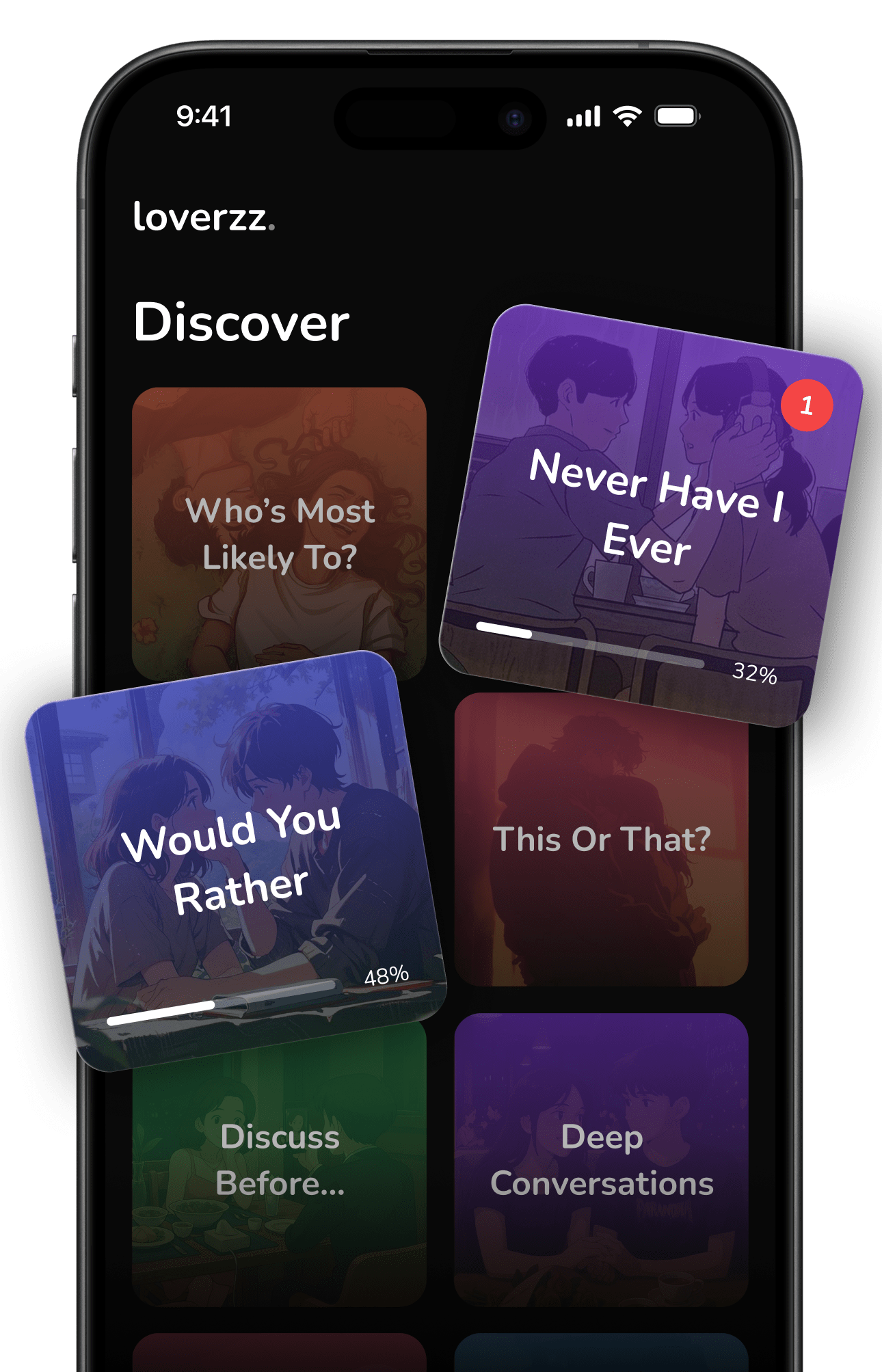
Loverzz is the couples app built around the same idea as the worm question. Small daily prompts, answered privately, then unlocked together. A shared memory feed for the answers worth keeping. Couple quizzes for the nights you want to play.
If the worm question made your partner laugh, Loverzz is the calmer, less viral version of the same conversation. Less ambush. More everyday.
Try a question together tonight. Download Loverzz, free on iOS and Android.
Related Reading
Written by
Loverzz Team
